

Executive Summary
Contract Research Organizations (CROs) play a critical role in modern clinical development. Sponsors increasingly rely on CROs not only to execute studies efficiently but also to provide strategic guidance, operational expertise, and technology infrastructure that can accelerate timelines while maintaining regulatory compliance.
At the center of this technology stack is the Electronic Data Capture (EDC) system.
An EDC platform is no longer simply a database for collecting patient information. Modern clinical trial software must support study startup, data management, remote monitoring, patient engagement, protocol amendments, regulatory compliance, and decentralized trial workflows. The right platform can reduce implementation timelines, improve study oversight, and create a better experience for sponsors, sites, and patients. The wrong platform can lead to delays, increased costs, operational inefficiencies, and frustrated study teams.
For CROs managing multiple sponsors and diverse protocols, selecting the right EDC platform is especially important. Unlike sponsors who may operate a limited number of studies, CROs often support dozens of active projects simultaneously across multiple therapeutic areas and geographic regions. Their technology must therefore be flexible, scalable, and capable of adapting to different sponsor requirements without extensive reconfiguration.
This guide examines the leading EDC platforms used by CROs in 2026 and evaluates their strengths, limitations, and ideal use cases. Whether you are a growing CRO seeking your first enterprise-grade EDC system or an established organization evaluating alternatives to legacy platforms, this article provides a practical framework for making an informed decision.
Quick Answers for CRO Buyers
What is the best EDC platform for CROs?
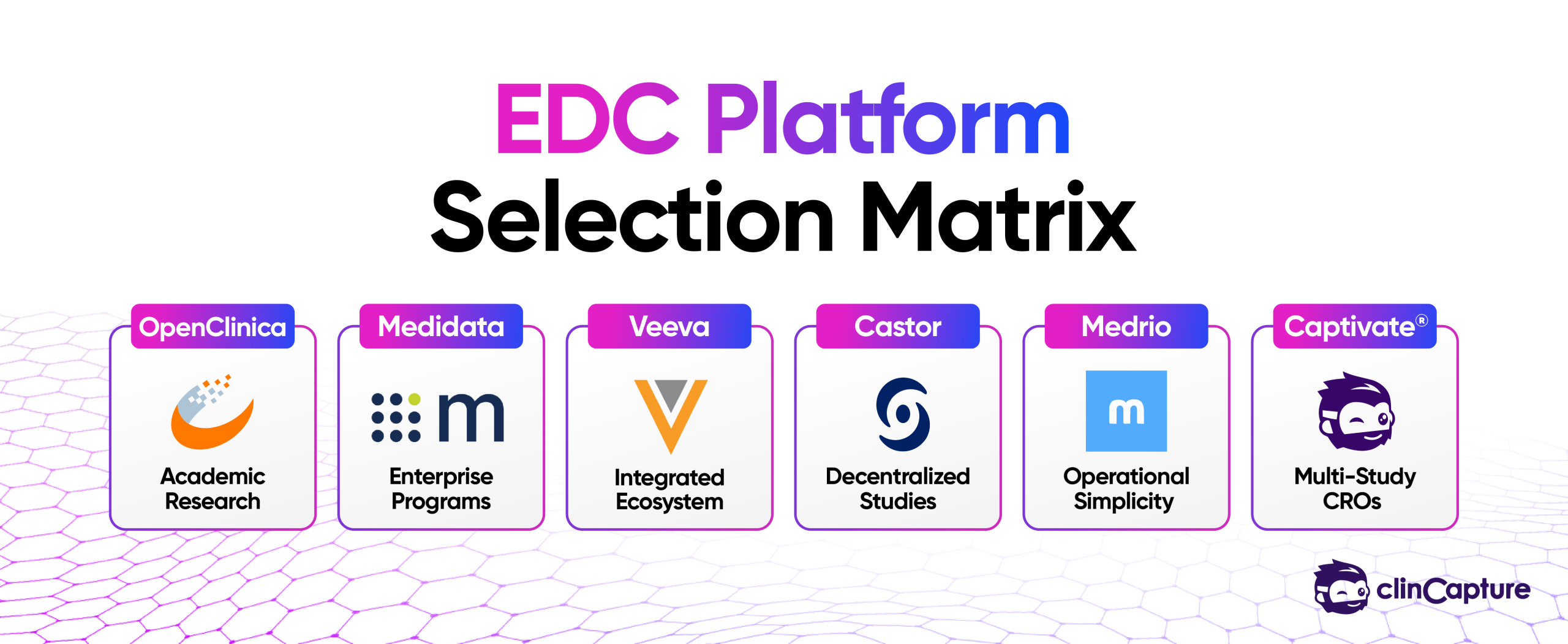
The best EDC platform for CROs depends on study complexity, sponsor requirements, budget, and operational workflows. Captivate®, Medidata Rave, OpenClinica, Veeva Vault EDC, Castor EDC, and Medrio are among the most widely used solutions. CROs typically prioritize flexibility, study startup speed, reporting capabilities, decentralized trial support, and scalability when selecting an EDC system.
Which EDC platform is best for decentralized clinical trials?
Platforms such as Captivate®, Castor EDC, Medidata Rave, and Veeva Vault EDC offer strong support for decentralized and hybrid clinical trials through technologies including ePRO, eConsent, remote monitoring, and virtual patient engagement.
Which EDC software is easiest to implement?
Organizations often select Captivate®, Medrio, and Castor EDC when rapid study startup and streamlined deployment are priorities. These platforms emphasize ease of configuration and reduced implementation complexity.
Which EDC platform offers the most customization?
Captivate® and OpenClinica are frequently chosen when organizations require advanced workflow customization, dynamic forms, configurable logic, and support for unique protocol requirements.
What should CROs consider when choosing an EDC platform?
CROs should evaluate study startup speed, customization flexibility, compliance capabilities, reporting functionality, decentralized trial readiness, scalability, infrastructure architecture, and total cost of ownership.
Why EDC Selection Matters for CROs
The technology decisions made by a CRO affect far more than data collection. EDC platforms influence nearly every stage of the clinical trial lifecycle, including database design, site activation, monitoring activities, data review, query management, and database lock.
A platform that supports efficient workflows can help CROs onboard sponsors more quickly, launch studies faster, and maintain consistent quality across multiple projects. Conversely, systems that require lengthy implementation cycles or excessive vendor involvement can create operational bottlenecks and increase project costs.
As sponsors place greater emphasis on transparency and performance metrics, CROs increasingly need systems capable of delivering real-time reporting and operational visibility. Modern EDC platforms have evolved beyond simple databases to become strategic operational tools that help research organizations improve efficiency and competitiveness.
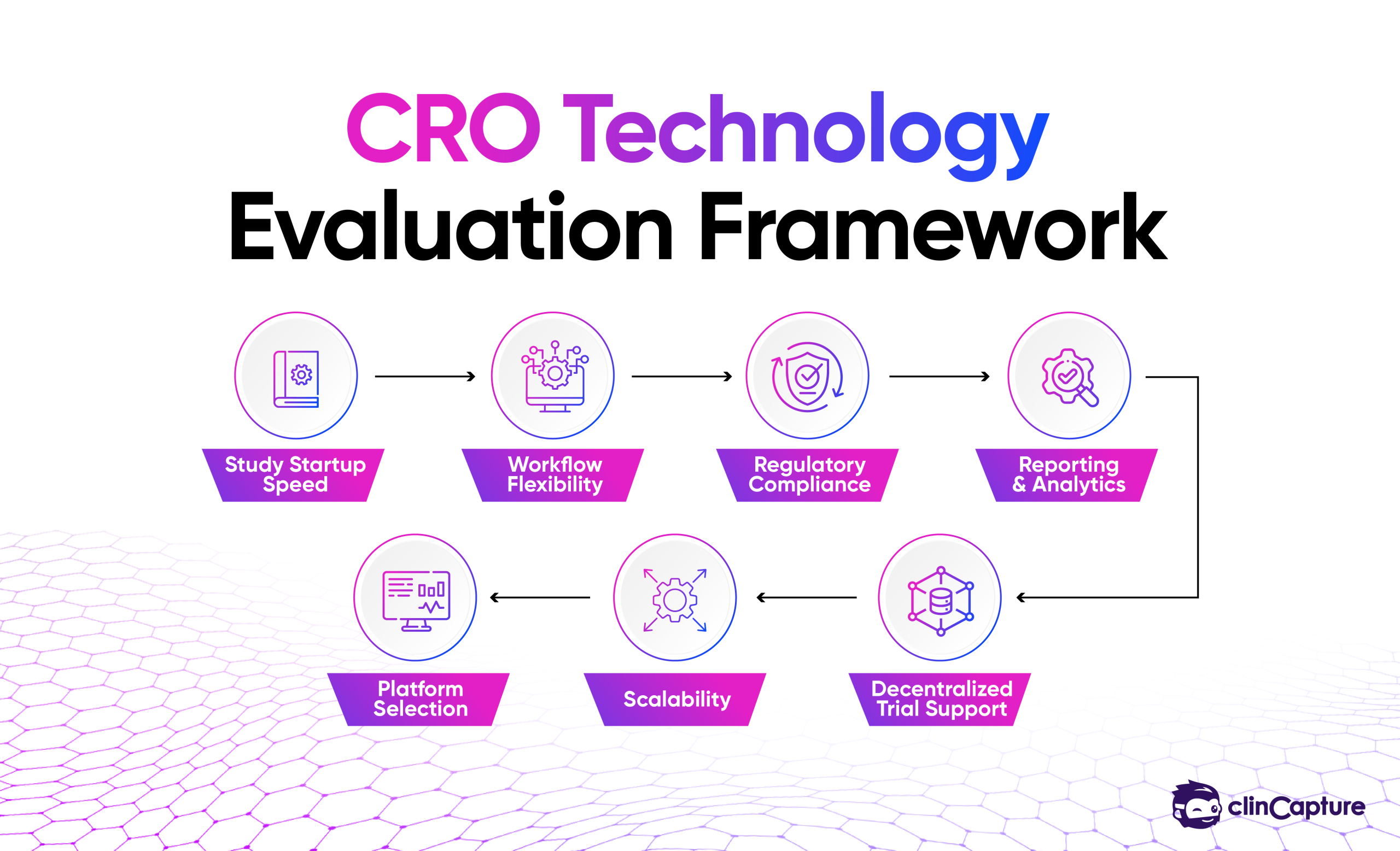
How We Evaluated the Leading EDC Platforms
To provide a meaningful comparison, each platform was evaluated across six categories that matter most to CROs.

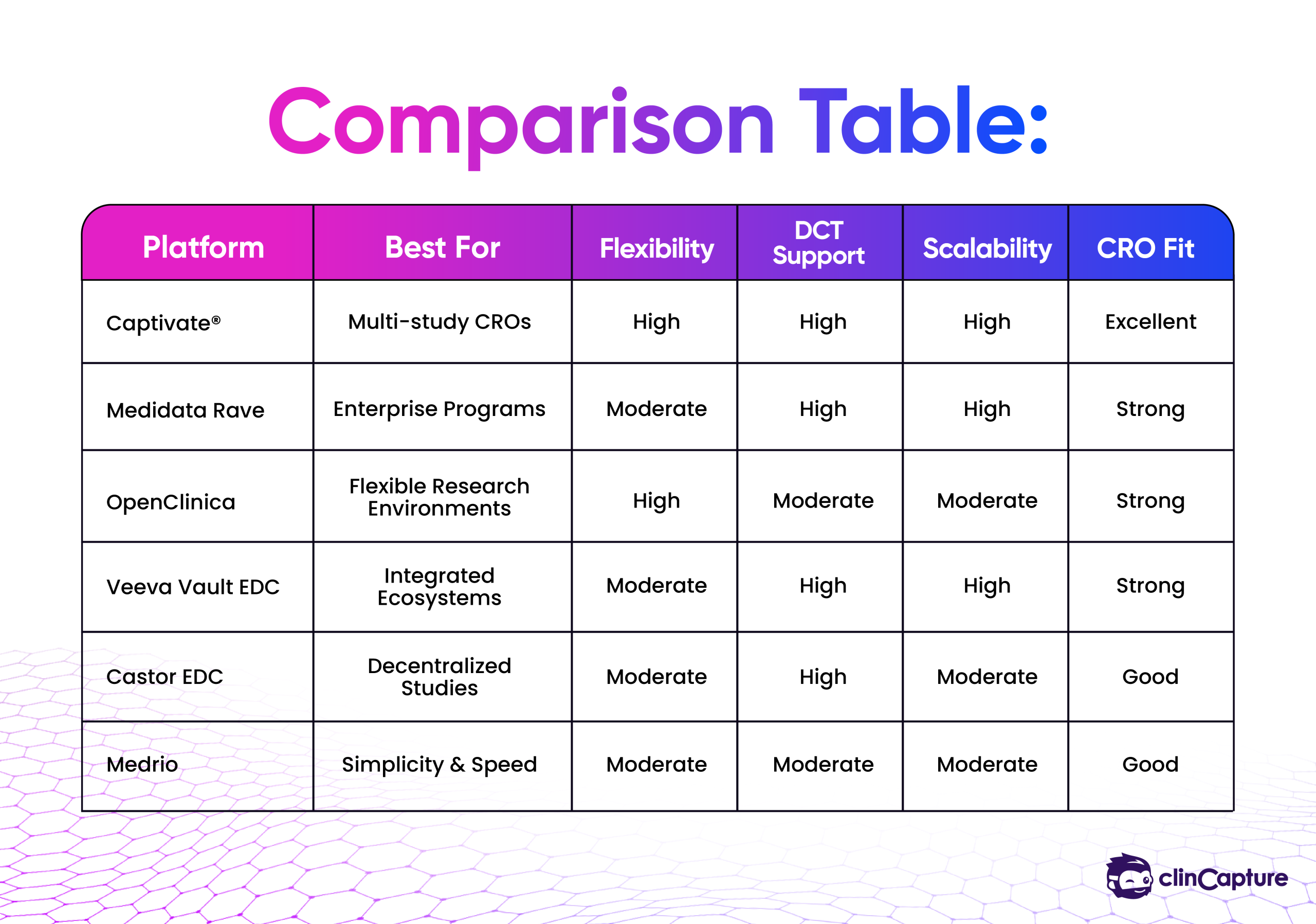
1. Captivate® — Best Overall EDC Platform for CROs
Today's CROs face increasing pressure to support more complex protocols, decentralized workflows, and sponsor-specific requirements without increasing operational overhead. Many traditional systems were designed for a different era of clinical research and often require significant vendor involvement for modifications or protocol changes.
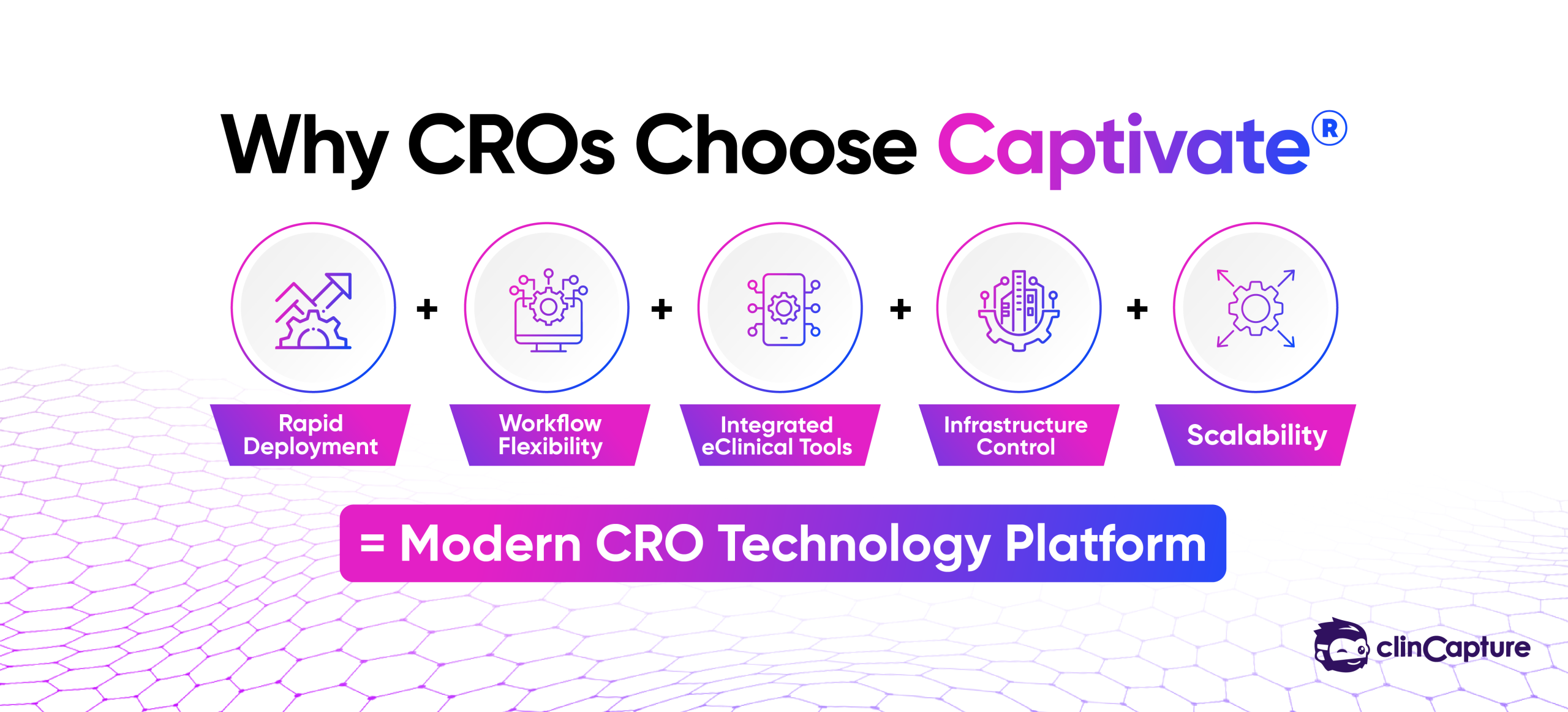
Captivate® addresses these challenges through a flexible and modern architecture that combines EDC, ePRO, eConsent, RTSM, analytics, and decentralized trial functionality within a unified platform. This integrated approach reduces the need for multiple disconnected systems and simplifies study management across diverse research programs.
One of the platform's key strengths is flexibility. CROs frequently manage sponsors with very different operational requirements, and Captivate® allows teams to configure workflows, forms, and study logic to meet those needs without sacrificing efficiency.
Key Advantages
Best For
2. Medidata Rave — Best Enterprise EDC Platform
Medidata Rave has been one of the dominant EDC systems in clinical research for many years and remains widely used across large pharmaceutical organizations and global CROs.
Its greatest strength lies in enterprise scalability and broad market adoption. Many sponsors are already familiar with Medidata, which can simplify collaboration and reduce training requirements for experienced study teams.
The platform supports large multinational trials and provides access to a wider ecosystem of clinical research technologies. For CROs working primarily with major pharmaceutical sponsors, Medidata may align closely with client expectations.
However, organizations evaluating modern alternatives often cite concerns around implementation timelines, customization complexity, and overall cost of ownership.
Key Advantages
Considerations
3. OpenClinica — Best for Flexible Research Workflows
OpenClinica has established itself as a trusted platform among academic institutions, government-funded programs, and organizations seeking greater flexibility in clinical data management.
Its open and configurable architecture allows research teams to adapt workflows to unique study requirements. For CROs supporting investigator-led studies or specialized research programs, this flexibility can be highly valuable.
Organizations with internal technical expertise often appreciate the control OpenClinica provides, although managing and maintaining custom environments may require additional resources.
Key Advantages
Best For
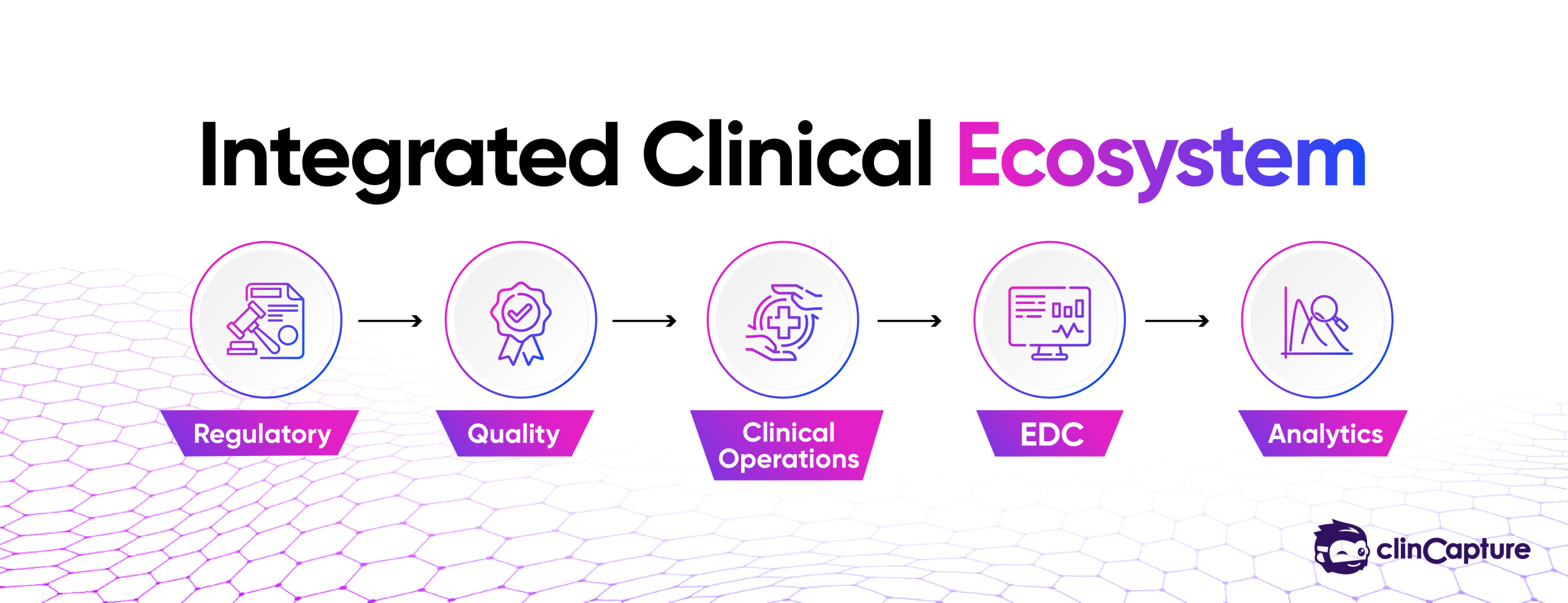
4. Veeva Vault EDC — Best Integrated Clinical Ecosystem
Veeva Vault EDC is part of a broader suite of clinical, quality, and regulatory applications. Organizations already invested in the Veeva ecosystem often benefit from seamless integration across departments and processes.
The platform emphasizes governance, consistency, and centralized management. This makes it particularly attractive to large organizations operating globally and requiring standardized workflows.
For CROs supporting enterprise pharmaceutical clients, Veeva's ecosystem can create efficiencies by reducing data silos and improving information sharing across teams.
Key Advantages
Best For
5. Castor EDC — Best for Decentralized Research
Castor EDC has gained popularity among organizations embracing patient-centric research and decentralized clinical trial models. Its modern interface and streamlined workflows make it accessible for both sites and research teams.
The platform supports remote participation, patient-reported outcomes, and virtual engagement, helping organizations improve recruitment and retention while reducing participant burden.
For CROs focused on decentralized and hybrid studies, Castor provides a practical balance between usability and functionality.
Key Advantages
Best For
6. Medrio — Best for Operational Simplicity
Medrio focuses on usability and ease of implementation. Many emerging biotech companies and smaller CROs select Medrio because teams can become productive quickly without extensive technical training.
The platform simplifies administration and study configuration while maintaining support for regulated research environments.
For organizations seeking a straightforward and efficient EDC solution, Medrio can provide a practical alternative to larger enterprise platforms.
Key Advantages
Best For
Which EDC Platform Should Your CRO Choose?
Every CRO operates differently, which means there is no single platform that is perfect for every organization.
Choose Captivate® If:
Choose Medidata Rave If:
Choose OpenClinica If:
Choose Veeva Vault EDC If:
Choose Castor EDC If:
Choose Medrio If:
Frequently Asked Questions
What is an EDC platform for CROs?
An EDC platform is software used by Contract Research Organizations to collect, manage, validate, and monitor clinical trial data electronically throughout the study lifecycle.
Which EDC platform is most commonly used by CROs?
Medidata Rave, Captivate®, Veeva Vault EDC, OpenClinica, Castor EDC, and Medrio are among the most commonly used platforms.
Which EDC system is best for decentralized clinical trials?
Platforms that integrate ePRO, eConsent, remote monitoring, and patient engagement capabilities are generally best suited for decentralized clinical research.
What should CROs look for when selecting EDC software?
Organizations should evaluate flexibility, compliance, deployment speed, reporting capabilities, scalability, infrastructure architecture, and total cost of ownership.
Is Captivate® suitable for large CROs?
Yes. Captivate® is designed to support multiple studies, diverse sponsor requirements, decentralized workflows, and scalable clinical research operations.
Which EDC platform is easiest to implement?
Many organizations consider Captivate®, Medrio, and Castor EDC among the easiest systems to deploy due to streamlined configuration processes.
What are alternatives to Medidata Rave?
Common alternatives include Captivate®, OpenClinica, Veeva Vault EDC, Castor EDC, and Medrio.
Does Captivate® support ePRO and eConsent?
Yes. Captivate® includes integrated ePRO and eConsent functionality within its broader eClinical ecosystem.
Which EDC software provides the most customization?
Captivate® and OpenClinica are frequently selected when advanced customization and protocol-specific workflows are required.
Can CROs manage multiple studies within Captivate®?
Yes. Captivate® is designed to support multi-study environments and diverse sponsor portfolios within a scalable platform architecture.
Conclusion
As CROs continue to navigate increasingly complex clinical trial environments, selecting the right Electronic Data Capture (EDC) platform has become a strategic business decision. Today's CROs need more than a system for collecting clinical data—they need technology that accelerates study startup, supports decentralized trial models, adapts to diverse sponsor requirements, and scales efficiently across multiple studies.
This is why many research organizations are moving beyond traditional EDC platforms and evaluating more flexible, modern solutions. Captivate® was designed specifically to help CROs streamline study execution through configurable workflows, integrated ePRO and eConsent capabilities, dedicated Private Clinical Cloud® infrastructure, and rapid study deployment tools. By reducing implementation complexity and minimizing dependence on external services, Captivate® enables clinical teams to focus on study delivery rather than software limitations.
For CROs seeking a platform that combines compliance, flexibility, scalability, and operational efficiency, Captivate® offers a modern approach to clinical trial data management. As research models continue to evolve, organizations that invest in adaptable technology will be best positioned to meet sponsor expectations, improve study performance, and support long-term growth.