

Executive Summary
Selecting the right Electronic Data Capture (EDC) platform can have a significant impact on clinical trial timelines, operational efficiency, study costs, and data quality. Among the most frequently compared solutions are Medidata Rave and Captivate® EDC by ClinCapture.
Both platforms support electronic data capture, study management, and regulatory compliance, but they are designed with different priorities in mind. Medidata Rave is widely recognized as an enterprise platform used by many large pharmaceutical organizations, while Captivate® focuses on flexibility, rapid deployment, modern cloud infrastructure, and operational control for sponsors and CROs.
For organizations evaluating clinical trial software in 2026, the decision often comes down to implementation speed, customization requirements, scalability, and total cost of ownership.
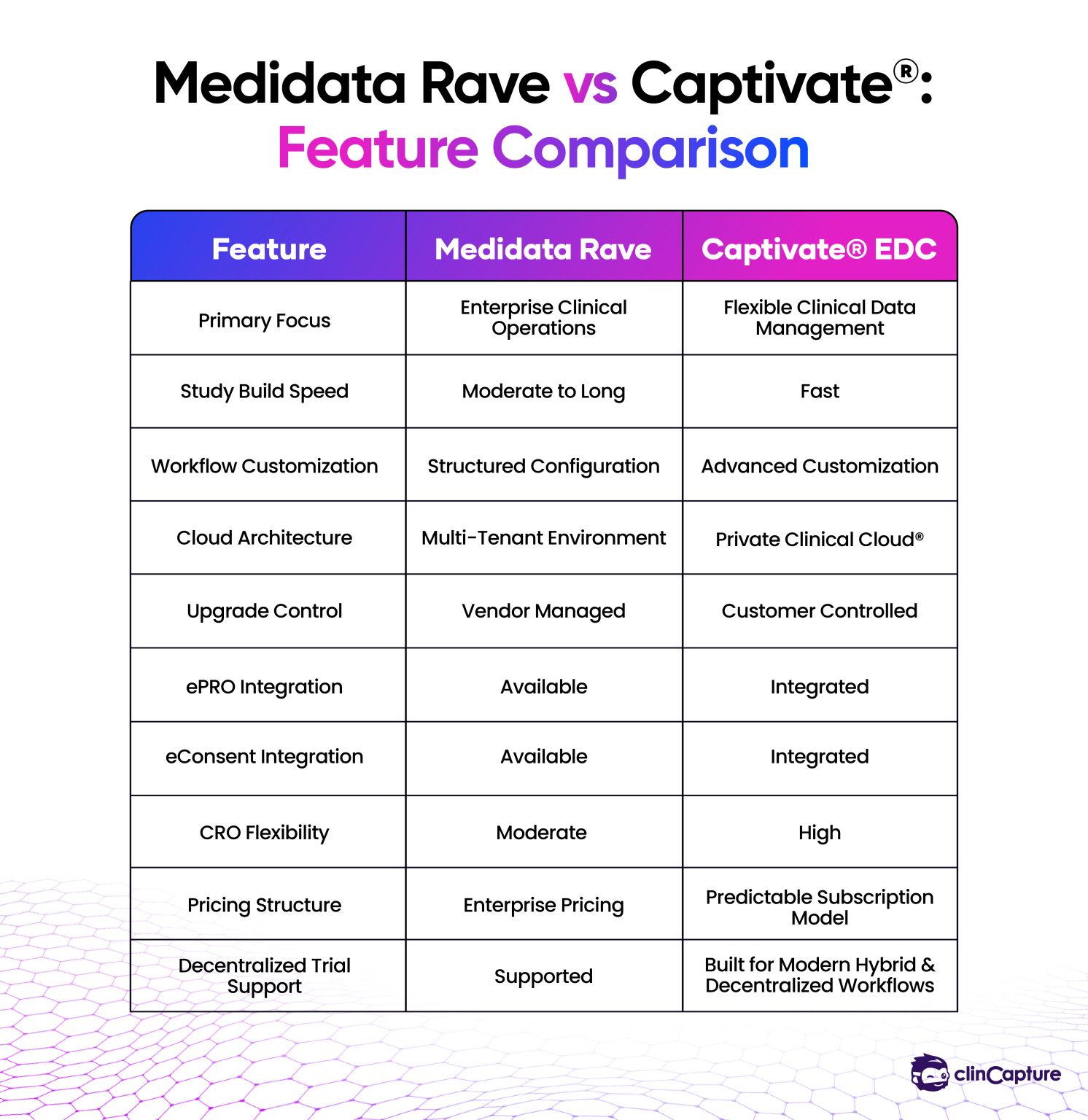
This guide compares Medidata Rave and Captivate® across key areas including study build timelines, customization, cloud architecture, compliance, reporting, pricing considerations, and decentralized trial readiness.
Comparing enterprise clinical trial infrastructure, deployment flexibility, and decentralized research readiness.
Quick Answer
What is the difference between Medidata Rave and Captivate®?
Medidata Rave and Captivate® are both Electronic Data Capture platforms used in clinical research. Medidata is commonly used by large enterprise pharmaceutical organizations and offers a broad ecosystem of clinical technologies. Captivate® is designed to provide faster study deployment, greater workflow flexibility, dedicated cloud environments, and predictable pricing for sponsors and CROs seeking modern clinical trial infrastructure.
Understanding Medidata Rave
Medidata Rave is one of the most established Electronic Data Capture platforms in the clinical research industry. It is widely used across global pharmaceutical organizations and supports large-scale clinical trial programs across multiple therapeutic areas.
Over the years, Medidata has expanded beyond traditional EDC functionality into a broader clinical trial ecosystem that includes data management, patient engagement technologies, analytics, and operational tools.
Organizations often choose Medidata because of its:

Medidata Rave is widely adopted across large pharmaceutical organizations requiring enterprise-scale governance, global deployment support, and integrated clinical operations.
For large pharmaceutical companies operating complex multinational studies, Medidata remains one of the most recognized clinical technology platforms available.
However, many organizations evaluating EDC software today are also looking at implementation flexibility, deployment speed, and operational costs, which has led to increased interest in alternative platforms.
Understanding Captivate® EDC
Captivate® is the modern Electronic Data Capture platform developed by ClinCapture. The platform was designed to help sponsors and CROs streamline study management without the complexity often associated with legacy enterprise systems.
Captivate® combines EDC functionality with an integrated clinical technology ecosystem that includes:
Captivate® is designed to support faster deployment, configurable workflows, and operational flexibility for sponsors and CROs managing modern clinical research programs.
One of the platform's distinguishing characteristics is its focus on flexibility and customer control. Organizations can configure workflows, customize study experiences, and manage infrastructure without relying heavily on vendor-driven services.
Captivate® is frequently selected by organizations seeking:
Study Build Speed and Deployment Timelines
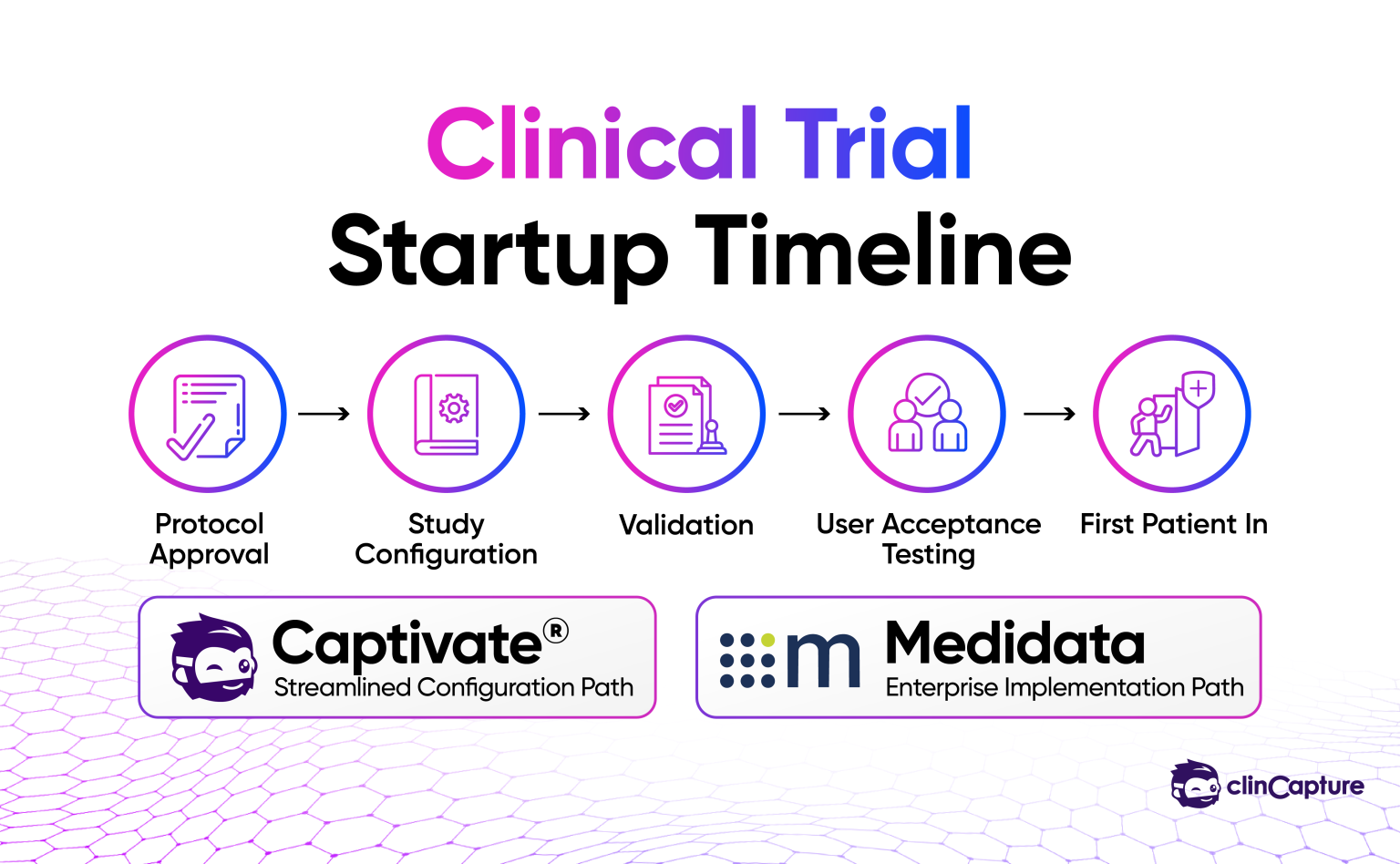
Study startup timelines have become increasingly important as sponsors seek to accelerate patient recruitment and reduce time-to-market.
Traditional enterprise platforms often involve extensive configuration processes, validation requirements, and implementation services before a study can launch. While this approach can provide structure, it may also increase deployment timelines.
Captivate® is designed to simplify study setup through reusable templates, AI-assisted workflows, and streamlined deployment infrastructure.
Deployment Advantages
For sponsors managing multiple concurrent studies, faster deployment can create meaningful operational advantages throughout the clinical development lifecycle.
Flexibility and Customization
Not all clinical trials follow standard workflows.
Adaptive designs, decentralized studies, and complex protocols often require customized logic, forms, and workflows that extend beyond basic study configurations.
Captivate® provides flexible workflow customization capabilities designed to support modern decentralized and adaptive clinical trial requirements.
Captivate® Customization Capabilities
This flexibility enables organizations to support unique protocol requirements without excessive vendor involvement.
Medidata offers structured configuration capabilities as part of its enterprise ecosystem.
Enterprise Governance Approach
More advanced customization requirements may involve formal implementation processes depending on governance models, study complexity, and operational requirements.
Cloud Infrastructure and Environment Control
Clinical trial infrastructure has evolved significantly as organizations move toward cloud-based deployment models.
One of the most notable differences between the two platforms is infrastructure management.
Medidata primarily operates within a multi-tenant architecture where updates and platform changes are managed centrally.
Benefits include:
Captivate®
Captivate® utilizes a Private Clinical Cloud® model that provides dedicated environments for sponsors and CROs.
Benefits include:
For organizations with strict validation requirements, dedicated infrastructure can simplify change management and regulatory planning.
Reporting and Data Visibility
Modern clinical trial teams require real-time access to operational and clinical data.
Both platforms provide reporting capabilities, but organizations increasingly prioritize:
Modern research organizations increasingly rely on centralized reporting infrastructure to monitor study operations, enrollment progress, and data quality metrics in real time.
Captivate® Reporting Infrastructure
Captivate® provides direct access to reporting and analytics tools designed to support rapid operational decision-making across clinical programs.
Support for Decentralized Clinical Trials
The rise of decentralized and hybrid clinical trial models has changed how sponsors evaluate software platforms.
Today's clinical trial technology must support:
Captivate® was designed with modern decentralized workflows in mind and integrates directly with connected patient engagement and virtual trial technologies.
Integrated Technologies
This integrated approach helps reduce technology fragmentation while supporting patient-centric study designs.
Pricing Considerations
Pricing is often one of the most important factors during vendor evaluation.
While exact pricing varies based on study design, deployment scope, and service requirements, organizations typically evaluate:
Many sponsors exploring alternatives to legacy enterprise platforms are primarily focused on improving predictability and reducing total cost of ownership across larger study portfolios.
Captivate® is frequently considered by organizations seeking scalable infrastructure and more predictable operational planning across growing clinical programs.
Captivate® Advantages
Which Platform Is Better for CROs?
CROs often require:
CROs frequently prioritize platforms capable of supporting multiple study designs while minimizing operational bottlenecks and implementation overhead.
Captivate® for CROs
Captivate® is particularly attractive to CROs managing diverse study designs because it provides greater flexibility while reducing reliance on external implementation resources.
Which Platform Is Better for Sponsors?
Large pharmaceutical organizations may prioritize:
Emerging Sponsor Priorities
Meanwhile, biotech companies and emerging sponsors often prioritize:
The best choice ultimately depends on organizational structure, study complexity, and operational priorities.
When Medidata Rave May Be the Better Choice
Medidata may be a strong fit for organizations that:
When Captivate® May Be the Better Choice
Captivate® may be a strong fit for organizations that:
Frequently Asked Questions
Is Captivate® an alternative to Medidata Rave?
Yes. Captivate® is frequently evaluated as an alternative by sponsors and CROs seeking flexible study configuration, faster deployment, and lower operational complexity.
What is the difference between Medidata and Captivate®?
The primary differences involve implementation approach, customization flexibility, cloud architecture, and operational control.
Which EDC platform is easier to customize?
Organizations requiring custom workflows, dynamic forms, and advanced study logic often prioritize platforms that support flexible configuration and scripting capabilities.
Can clinical studies be migrated from Medidata?
Clinical trial data can typically be exported, validated, and migrated according to study requirements and regulatory standards.
Does Captivate® support decentralized clinical trials?
Yes. Captivate® supports decentralized and hybrid clinical trial workflows through integrated ePRO, eConsent, and virtual data capture capabilities.
What are alternatives to Medidata Rave?
Common alternatives include Captivate®, Veeva Vault EDC, Medrio, Castor EDC, OpenClinica, and REDCap depending on study requirements and organizational needs.